Your first alert
Ten minutes. You end with a message in Teams, Slack or your inbox the next time a check breaches — and silence when nothing changed.
1. Decide where alerts go
Alerts are configured per suite, so the team that owns the data gets told about its data. Workspace-wide defaults (a Slack webhook, an SMTP sender, a Teams webhook) are set by whoever deployed DataQ through environment configuration; a suite can override the Teams webhook and the email recipients.
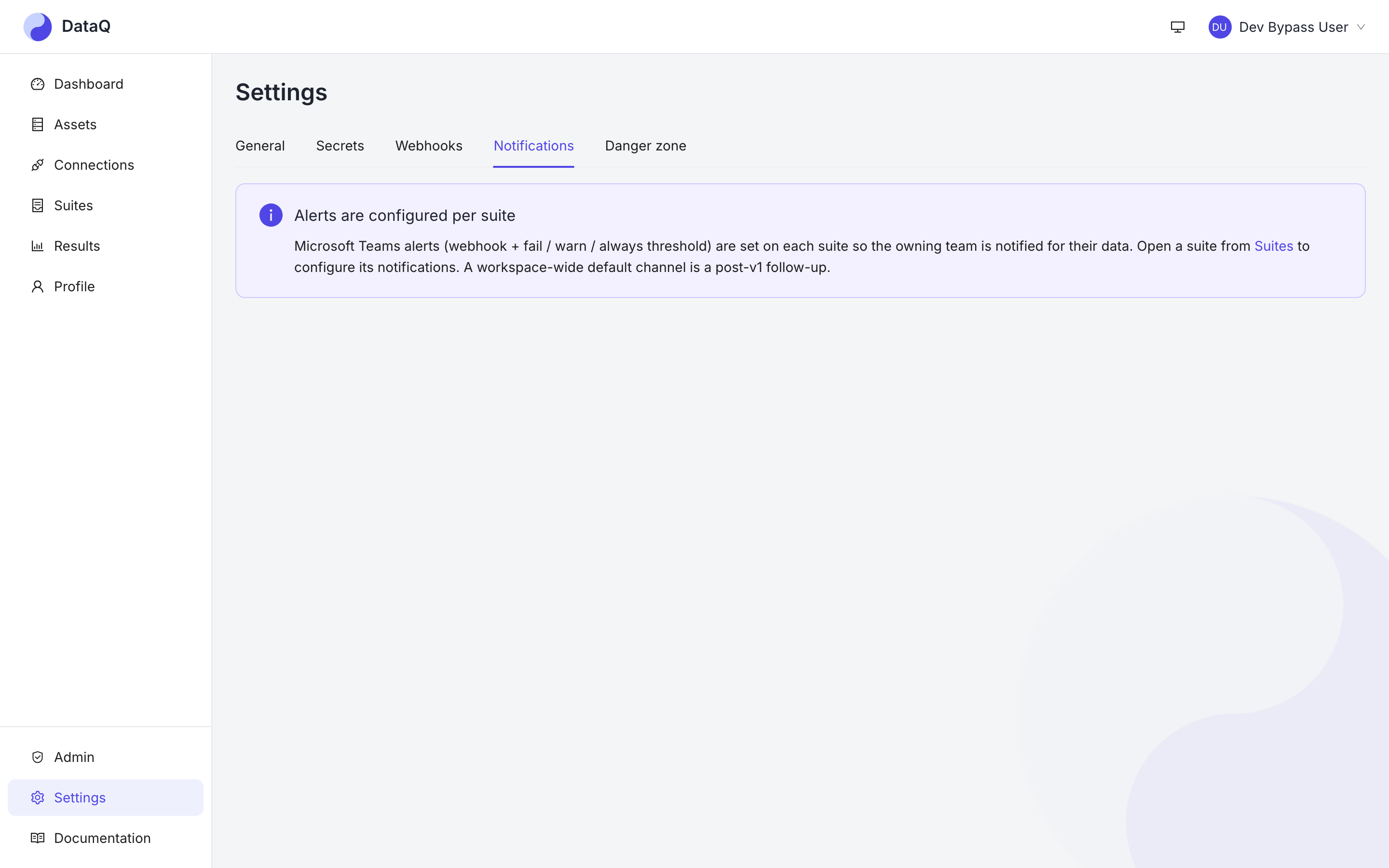
Destinations live here; each suite decides which of them it uses and when.
2. Turn alerts on for the suite
Open the suite and scroll to Notifications:
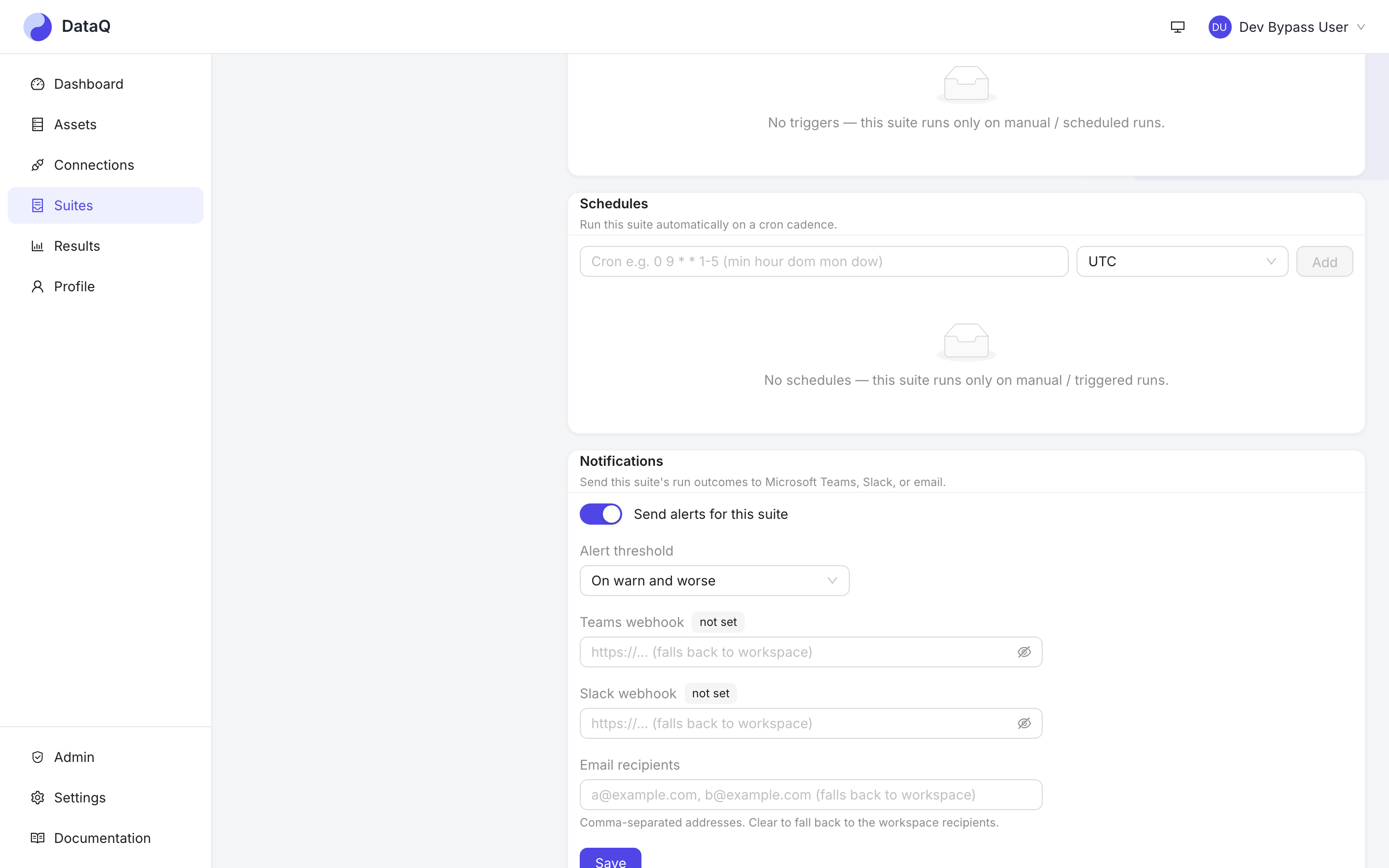
Everything an alert needs, on the suite itself.
- Switch Send alerts for this suite on.
- Pick the alert threshold. The default, On warn and worse, is the right first choice: quiet for a passing run, loud the moment a check crosses a threshold you set.
- Optionally paste a Teams or Slack webhook for this suite, or list email recipients. Leave a field blank to fall back to the workspace default. Webhook URLs are write-only: after saving, the tag reads set and the URL is never shown again.
- Save.
3. Prove it fires
Edit a check so it must breach — set a warn threshold below today's unexpected-% you saw in
the dry-run — and click Run. Within seconds of the run finishing, the alert lands with the
suite name, the worst severity, the checks that breached and a link back to the run.
Put the threshold back afterwards. Now the same run is green and nothing fires: DataQ alerts only when a run got worse than the previous one (a newly failing check, or an escalation from warn to fail to critical), so a broken check on a 15-minute schedule reports once, not 96 times a day.
What else you get for free
- Severity-aware delivery —
criticalescalates (a channel mention on Teams),warnstays quiet. - Operational failures always alert — a run that could not execute (dead credential, unreachable store) notifies regardless of the threshold, with a plain-language reason.
- Snooze — from the suite's check list, silence one check for N hours during a known upstream incident; it un-snoozes itself.
- Incidents — a critical breach opens an incident on the asset, with an evidence card you can acknowledge and resolve from the run page or over MCP.
Everything above, in depth: Notifications & alerting.